Spring Faucet Vs Pull Down: Which Kitchen Tap Is Best for You?
When you walk into a modern kitchen, you’ll notice that the sink area has changed a lot over the last decade. The traditional faucet has evolved, and now you’ll often see two popular options: spring faucets and pull down faucets. Both look stylish and promise more flexibility than older types, but how do you know which one is right for your kitchen? The truth is, they’re not just about looks—each has unique strengths and some downsides that are easy to overlook if you’re only shopping by appearance.
Choosing between a spring faucet and a pull down faucet is not always simple. You need to consider how you cook, clean, and use your sink every day. What works well in a restaurant might not suit a small apartment. And sometimes, the features that sound great in ads can be frustrating in practice. In this guide, you’ll get a clear, side-by-side look at both options, along with some real-life examples and advice to help you decide. By the end, you’ll know exactly what to expect and how to pick the faucet that fits your needs best.
What Is A Spring Faucet?
A spring faucet is sometimes called a commercial-style or industrial faucet. The most noticeable feature is the high arc with a metal spring coil. This coil supports a flexible spray hose, which you can pull out and move around with ease. Originally, these were used in restaurant kitchens because they make it easy to clean large pots and pans and quickly rinse the sink. Now, many homeowners choose them for their bold look and powerful performance.
The spring not only adds style but also protects the hose, keeping it from kinking. Some spring faucets have a heavy-duty spray head with different spray patterns, and you can usually move the spray head in any direction. Many models have a docking system that holds the spray head in place when you’re not using it.
Key features of a spring faucet:
- Tall, high-arc design
- Exposed coil spring for flexibility
- 360-degree swivel for wide sink coverage
- Pull-down spray head with multiple functions
- Heavy-duty construction
Spring faucets are often a centerpiece in the kitchen. They stand tall, sometimes up to 24 inches, and catch your eye right away. But their size and bold look can be too much for some spaces.
What Is A Pull Down Faucet?
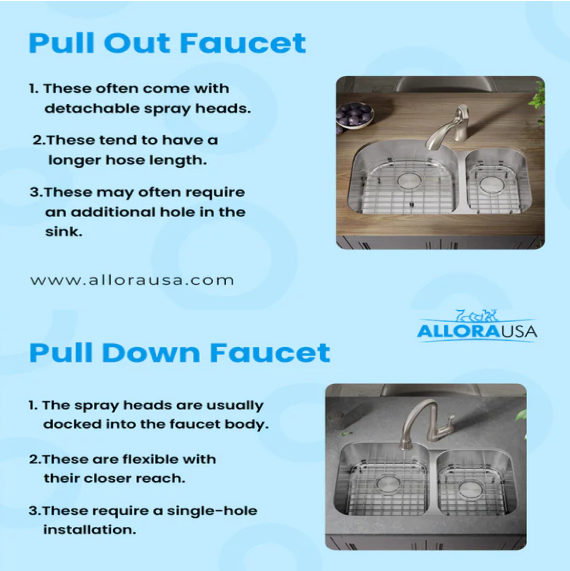
A pull down faucet is designed for everyday use in homes. It has a spray head that pulls straight down from the faucet spout on a flexible hose. When you let go, the spray head usually docks back with the help of a magnet or weight. These faucets are more streamlined, with a simple curve or slight arch—less industrial, more homey.
Pull down faucets are known for their easy one-handed operation. You can switch between stream and spray modes, making them great for rinsing dishes or filling pots. They come in many shapes and finishes, so you can find one that fits almost any kitchen style.
Key features of a pull down faucet:
- Moderate height (often 15–20 inches)
- Hidden hose design
- Simple, elegant arc
- Pull-down spray head for rinsing
- Docking system (magnetic or weighted)
Pull down faucets blend into the kitchen rather than standing out. They’re popular in many new homes and are often recommended for smaller kitchens or those with cabinets above the sink.

Credit: www.lowes.com
Design And Aesthetics
When you choose a faucet, the look matters almost as much as the function. Both types are stylish, but they send different messages.
Spring faucets make a bold statement. The coiled spring and high arc say “professional kitchen.” If you want your kitchen to look modern, industrial, or like a chef’s workspace, a spring faucet delivers that vibe. However, the large size may clash with more traditional kitchen styles.
Pull down faucets are more understated. Their curves are softer, and the hose is hidden, so they look tidy and modern, but not overwhelming. You’ll find these in nearly every finish, from stainless steel to matte black or brushed gold.
Design tip: If your kitchen has cabinets directly above the sink, a spring faucet can look cramped and might not fit at all. Always measure the vertical clearance before you buy.
Performance And Functionality
The main reason to upgrade to a spring or pull down faucet is to make your cleaning and cooking tasks easier. But the way each faucet works can make a big difference.
Spring Faucet Performance
Spring faucets shine when you need power and flexibility. The high arc and 360-degree swivel mean you can reach all corners of a double sink. The spray head is usually larger and delivers a strong spray, which is ideal for blasting food off plates or cleaning large pots.
Restaurants choose spring faucets for speed—rinsing many plates, filling buckets, or scrubbing pans. At home, they’re perfect if you cook a lot or handle big dishes often.
Non-obvious insight: The strong spray on some spring faucets can cause splashing if your sink is shallow. You may need to adjust your water pressure or be careful when rinsing.
Pull Down Faucet Performance
Pull down faucets are made for everyday convenience. The spray head pulls down smoothly and is easy to control with one hand. Most models let you switch between stream and spray by pressing a button.
They’re great for rinsing produce, filling pots on the counter, or washing dishes. Because the hose is hidden, the faucet always looks neat, even when not in use.
Non-obvious insight: The hose length on pull down faucets is often shorter than on spring models. If you need to fill a bucket on the floor or reach far outside the sink, a spring faucet might be better.
Installation And Fit
Not all sinks are the same, and neither are kitchens. How a faucet fits your space can be just as important as how it looks.
Spring Faucet Installation
Spring faucets are tall and need more vertical space. You’ll need to check for clearance under cabinets and shelves. Some models are heavy, so the sink or countertop must be sturdy.
They usually require a single hole in the sink or countertop, but some can cover old holes with a plate. Most homeowners can install a spring faucet with basic plumbing skills, but the size and weight can make it tricky.
Tip: If you have a window ledge or low-hanging light over your sink, double-check the measurements before buying a spring faucet.
Pull Down Faucet Installation
Pull down faucets are more compact and fit almost any kitchen. They’re easier to install and lighter, so you don’t need extra support. You can find models that work with single or multiple holes, depending on your current setup.
Because the hose is hidden inside the faucet body, there’s less to worry about when it comes to bumping into cabinets or windows.
Tip: If you’re replacing an old faucet, bring your measurements to the store or check online specs to ensure the new faucet will cover any extra holes or match your sink’s layout.
Durability And Maintenance
Kitchens are busy places, and your faucet will get a lot of use. Durability and ease of cleaning matter, especially if you want your faucet to look good for years.
Spring Faucet Durability
Spring faucets are built for hard work. The exposed coil is tough and less likely to wear out than a simple hose. The spray head is often made of metal and designed for frequent use.
However, the exposed parts can collect grease, dust, and water spots. Cleaning between the coils takes more time, and fingerprints show up easily on shiny finishes.
Maintenance tip: Wipe the coil and spray head with a damp cloth every week to prevent buildup. For deep cleaning, you may need a brush to get between the coils.
Pull Down Faucet Durability
Pull down faucets are usually made from stainless steel, brass, or zinc alloy. The hose is hidden, so there’s less risk of damage from knocks. The spray head is lighter, making it less tiring to use.
These faucets are easier to keep clean since there are fewer exposed parts. Most models have finishes that resist fingerprints and water spots, so they look newer longer.
Maintenance tip: Regularly pull out the spray head and check the hose for leaks or wear. Clean the spray nozzle to prevent mineral buildup, especially if you have hard water.
Cost And Value
Price is always a factor when upgrading your kitchen. Both types of faucets come in a wide price range, from budget models to high-end designer pieces.
Spring Faucet Costs
Spring faucets are often more expensive than pull down models. The price reflects the size, materials, and industrial design. You can find basic spring faucets for around $100, but top brands with advanced features can cost $300–$700.
Example: A commercial-style spring faucet from a well-known brand like Kohler or Moen often starts at $250 and goes up with more spray options or premium finishes.
Pull Down Faucet Costs
Pull down faucets are available at almost every price point. Entry-level models start around $50–$70, while mid-range options from trusted brands range from $150–$400.
Example: A high-quality pull down faucet with a magnetic docking system and a durable finish usually costs between $200 and $350.
Value tip: If you’re on a tight budget, you’ll find more options among pull down faucets. But if you want a statement piece and use your kitchen heavily, the extra investment in a spring faucet may be worth it.
Real-world Examples
Here’s how different kitchens might benefit from each faucet type:
- Busy family kitchen: A pull down faucet is perfect. It’s simple, safe for kids, and easy to keep clean.
- Home chef or entertainer: A spring faucet gives you the flexibility and power you need for large meals and heavy cookware.
- Small apartment: A compact pull down faucet makes the most of limited space and won’t clash with your cabinets.
- Open-concept kitchen: A spring faucet can become a design feature, making your kitchen stand out.
User Experience: Everyday Life
Both faucets are designed to make kitchen tasks easier, but the real test is how they feel day after day.
Using A Spring Faucet
People who cook often love the control and reach of a spring faucet. You can move the spray head anywhere, and the strong water flow cuts through stuck-on food. However, the height and industrial look can feel out of place in a cozy kitchen.
Some users also find that water splashes more if the sink isn’t deep enough.
Using A Pull Down Faucet
Pull down faucets are all about comfort. The lighter spray head and shorter hose mean less arm fatigue, and the faucet’s shape feels familiar. Most users appreciate how the spray head snaps back into place. However, if you have a very large sink, you might not be able to reach every corner as easily.
Water Flow And Spray Options
Modern faucets do more than just turn on and off. Both spring and pull down models offer multiple spray settings, but there are some differences.
Spring faucets usually have a strong spray and a pause button. Some let you switch between spray and stream, but the focus is on power and speed.
Pull down faucets often have two or three modes: stream, spray, and sometimes a “boost” setting for extra pressure. The controls are usually on the spray head for quick changes.
Statistic: According to industry data, 75% of homeowners say they use the spray function more than the stream, especially for rinsing dishes and cleaning produce.
Practical tip: If you rinse delicate fruits often, check that your faucet’s spray setting is gentle enough to avoid bruising.
Space And Compatibility
Your kitchen’s size and layout can be the deciding factor between these two faucet types.
Spring faucets require more space, both above and around the sink. They can dominate a small kitchen and look out of place if your counters are crowded.
Pull down faucets fit into almost any space. Their compact design is ideal for galley kitchens or sinks under cabinets. If you like a cleaner look or have limited room, pull down is usually the safer choice.
Space-saving idea: If you love the look of a spring faucet but your kitchen is small, look for a “mini” spring faucet. These offer the style but in a more compact size.
Table: Spring Faucet Vs Pull Down Faucet – Key Features
Here’s a side-by-side look at the main differences:
| Feature | Spring Faucet | Pull Down Faucet |
|---|---|---|
| Height | High (20–28 inches) | Moderate (15–20 inches) |
| Spray Head Reach | Long (up to 30 inches) | Medium (up to 18–20 inches) |
| Best For | Heavy-duty, large sinks | Everyday use, small/medium sinks |
| Style | Industrial, bold | Modern, subtle |
| Installation Difficulty | Medium–High | Low–Medium |
Table: Common Buyer Mistakes
Knowing what can go wrong helps you avoid costly errors.
| Mistake | Spring Faucet | Pull Down Faucet |
|---|---|---|
| Not measuring vertical space | Common | Rare |
| Choosing wrong finish for hard water | Possible | Possible |
| Underestimating spray strength | Very common | Sometimes |
| Ignoring installation weight | Common | Rare |
Table: Quick Comparison For Key Factors
| Factor | Spring Faucet | Pull Down Faucet |
|---|---|---|
| Cleaning | Requires more effort | Easy, less exposed parts |
| Price Range | $100–$700+ | $50–$400+ |
| Suitability for small sinks | Poor | Excellent |
| Suitability for deep sinks | Excellent | Good |
Pros And Cons Of Spring Faucets
Advantages:
- Powerful spray for tough cleaning jobs
- High reach and flexibility
- Professional, eye-catching look
- Ideal for large sinks or frequent cooking
Disadvantages:
- Can overwhelm small kitchens
- More difficult to clean (exposed coil)
- Higher price on average
- May cause splashing if sink is shallow
Pros And Cons Of Pull Down Faucets
Advantages:
- Sleek, modern look fits any kitchen
- Easier to clean and maintain
- Works well in small or medium spaces
- Usually more affordable
Disadvantages:
- Less reach and power compared to spring faucets
- Not as dramatic if you want a statement piece
- Hose may wear out faster with heavy use
Which Faucet Is Best For You?
If you cook large meals, use big pots, or love the industrial kitchen style, a spring faucet will serve you well. The extra reach and power are worth the investment. But if your kitchen is cozy, or you want something easy to use and maintain, a pull down faucet is the clear winner.
Think about your daily habits. Do you need to clean large trays or just rinse a few dishes? Is your sink deep and open, or small and tucked under a cabinet? These answers will guide you more than any brand or trend.
Expert Tips For Choosing
- Measure first. Double-check the height and reach before you buy, especially for spring faucets.
- Check your water pressure. Some spring faucets need good pressure to work well.
- Test the spray head. Some are heavier than others—make sure it feels comfortable for you.
- Look for easy-clean finishes. Brushed or matte finishes show fewer fingerprints.
- Read real reviews. Homeowners often share details about installation and daily use that aren’t in product descriptions.

Credit: www.youtube.com
When To Avoid Each Type
There are situations where one type simply isn’t the right choice:
- Spring faucet: Avoid if you have low cabinets, a shallow sink, or want a subtle look.
- Pull down faucet: Avoid if you regularly clean oversized cookware or have a very deep, wide sink.
Environmental Impact
Both faucets can help save water compared to older models, thanks to better spray controls and aerators. However, the actual savings depend on how you use them. A strong spray can use more water if left running, so choose a model with a pause button or water-saving setting if possible.
Statistic: The average kitchen faucet flows at 2.2 gallons per minute. Switching to a faucet with a pause or eco-mode can reduce water use by up to 30%.
For more information on water-saving kitchen fixtures, you can check out EPA WaterSense.
Credit: allorausa.com
Frequently Asked Questions
What Is The Main Difference Between A Spring Faucet And A Pull Down Faucet?
The biggest difference is in the design and flexibility. Spring faucets have an exposed coil and higher arc for more reach and a bold look. Pull down faucets are more compact, with a hidden hose and a softer curve that fits most home kitchens.
Are Spring Faucets Harder To Clean Than Pull Down Faucets?
Yes, spring faucets are generally harder to clean because the exposed coil can trap grease and dust. Pull down faucets have fewer exposed parts, so they’re easier to wipe down.
Can I Install A Spring Or Pull Down Faucet Myself?
Most people with basic DIY skills can install either faucet. However, spring faucets are heavier and taller, so they may be more challenging. Always check the instructions and your sink’s compatibility before starting.
Which Faucet Type Is Better For Small Kitchens?
Pull down faucets are usually better for small kitchens. Their compact design fits under cabinets and doesn’t overwhelm the space, while spring faucets need more room.
Do Both Faucets Offer The Same Spray Options?
Both types offer multiple spray options, but spring faucets often focus on strong, powerful sprays. Pull down faucets usually have more choices, like stream, spray, and sometimes a pause or boost feature.
Choosing between a spring faucet and a pull down faucet is not just about style—it’s about how you use your kitchen every day. Take the time to measure your space, think about your cleaning habits, and pick the faucet that will make your life easier and your kitchen more enjoyable. With the right choice, even washing dishes can feel like less of a chore.